Tape Speed
What it is
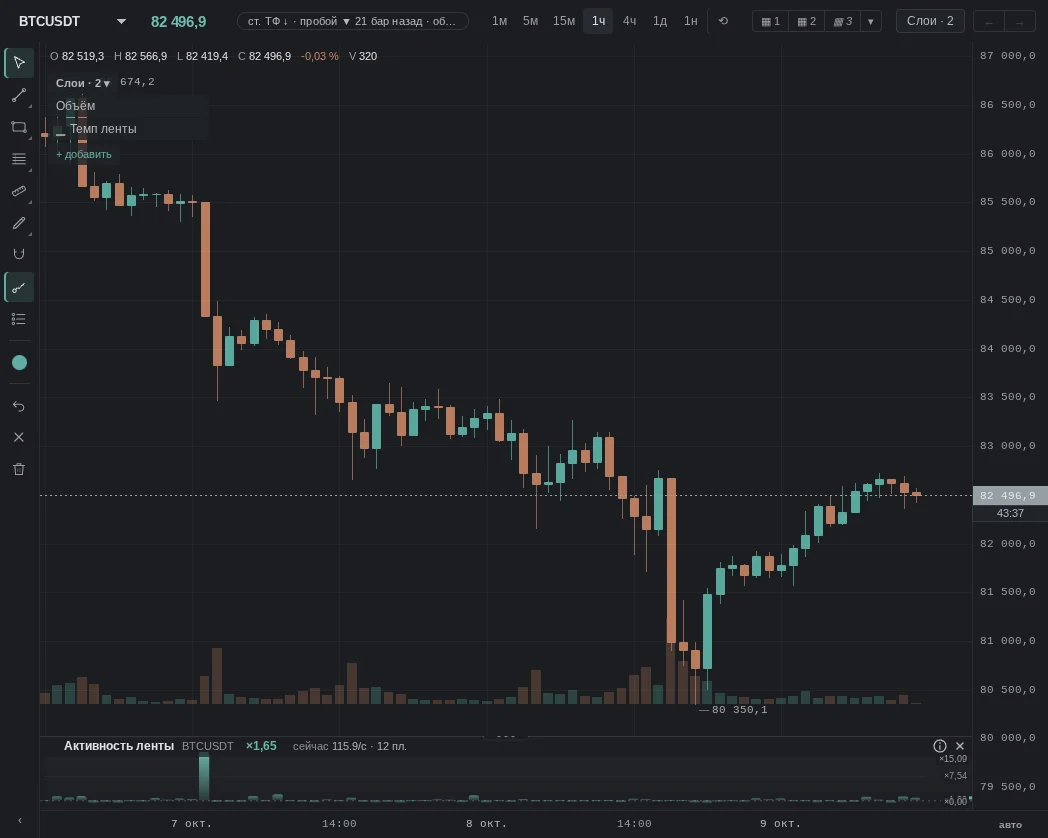
The tape is the stream of trades. The "Tape Speed" layer (the pane itself is labeled "Tape Activity") compares how many trades went through in a minute with the usual pace for this coin: 1 — as usual, 2 — twice as fast, 0.5 — half as busy. It does not show direction: it is trade frequency, not an imbalance. A faster tape means attention has come into the market — whose, and in which direction, the other panes answer.
We count the pace from trades on all our venues — futures and spot — and compare it with the usual pace of the same coin.
The pane scale follows the visible segment and only its own lines, with margin above and below; the dashed price line uses its own scale on top and does not affect the scale. Under the crosshair are the line values at that point, from the same starting point as the pane itself. When zoomed far out, individual spikes do not set the scale of the whole pane: a bar taller than the scale is clipped at the edge, marked at the edge, and the largest ones are labeled with their real value.
What it looks like in EVA
How it is read
Typical patterns: how they are read and how they are used. Examples from our history for these patterns will appear later — mechanical search has not found them yet, and we chose not to pick them by hand.
1. The tape speeds up on a level breakout
How traders read it: new participants are joining the move. Many consider a breakout without a faster tape suspicious, and one with it alive.
An example will appear later.
2. The tape boils after a long move
How traders read it: everyone is rushing at once — chasing or heading for the exit. Many see this as a climax after which the move tires.
An example will appear later.
3. The tape is quieter than usual
How traders read it: participants are waiting. Many do not trust moves on an empty tape and wait for the pace to return.
An example will appear later.
When it does not work
No pattern works every time: tape speed explains better that attention has arrived than it tells in which direction.
Common traps
- Bots: some trades are small automated ones; they inflate the count without big money.
- News speeds up the tape in both directions at once — there is pace but no direction.
- Night and weekends: the "usual pace" is based on the last two hours, so a quiet hour is compared with quiet hours.
- A venue went silent — it drops out of both the count and the norm; the number of venues is shown in the header.
See also
- Taker Aggression — which side is hitting on a fast tape.
- Large Trades — whether there is notable money among them.
- CVD — whether an imbalance is building up.
- Volume — how much money went through, not how many trades.